

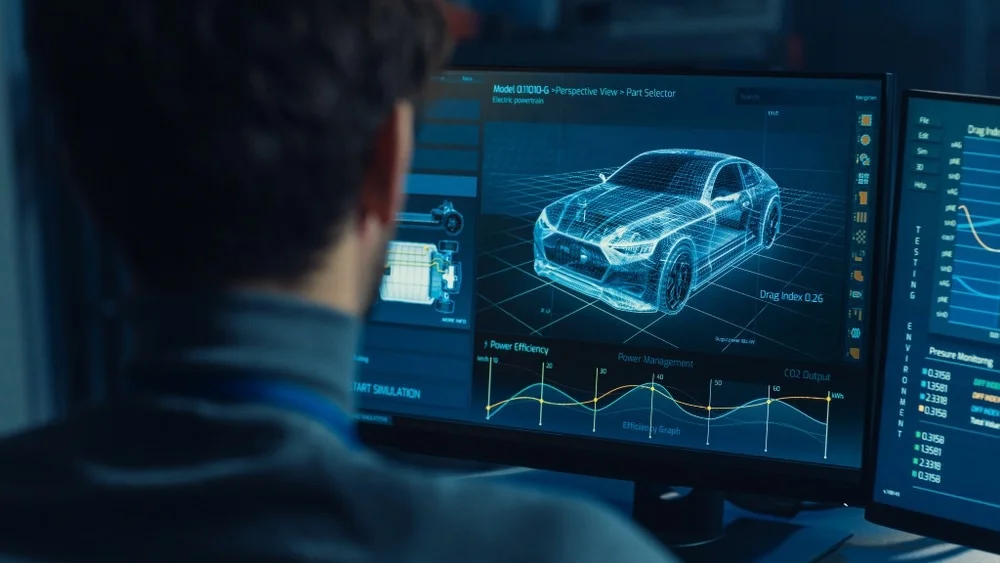
The automotive manufacturing landscape is undergoing its most profound transformation since Henry Ford introduced the moving assembly line. The contemporary automotive plant is no longer merely a site of mechanical assembly. Instead, it has evolved into a highly integrated, software-driven ecosystem where physical infrastructure and digital intelligence merge seamlessly. Driven by the dual imperatives of rapid technological evolution and aggressive sustainability targets, automakers are fundamentally restructuring how vehicles are conceptualized, built, and delivered.
Several foundational innovations are redefining the factory floor. By leveraging artificial intelligence, next-generation connectivity, advanced structural casting, and sustainable materials, the modern automotive manufacturing sector is unlocking unprecedented levels of efficiency, customization, and environmental responsibility.
The Convergence of Artificial Intelligence and Computer Vision
Artificial intelligence has matured from a predictive maintenance tool into the operational brain of the modern automotive factory. Historically, quality control relied heavily on end-of-line inspections, where defects were identified only after a vehicle was fully assembled. This late-stage detection frequently resulted in expensive reworks, scrapped components, and heightened warranty risks.
Today, industrial computer vision systems powered by deep learning algorithms are integrated directly into the assembly process. High-resolution cameras monitor every stage of production, from the initial stamping of sheet metal to the final application of adhesive beads. By cross-referencing real-time visual data with structural parameters such as vibration patterns, torque curves, and temperature fluctuations, these systems can identify micro-defects invisible to the human eye.
Furthermore, generative AI copilots are revolutionizing how maintenance teams manage equipment downtime. When an automated station experiences an anomaly, the AI assistant parses vast repositories of technical manuals, historical repair logs, and engineering schematics to provide technicians with natural language diagnostics and targeted remediation strategies. This shift from reactive troubleshooting to real-time, preventative optimization ensures that the manufacturing loop remains uninterrupted, dramatically reducing operational friction.
Mega-Casting and Structural Optimization
One of the most radical physical disruptions in automotive assembly is the adoption of mega-casting, often referred to as giga-casting. Traditional vehicle manufacturing requires stamping dozens of individual steel or aluminum components and subsequently welding, riveting, or bonding them together to form the structural chassis of the vehicle. This methodology introduces structural complexity, adds significant weight, and requires a massive footprint of robotic welding stations.
Mega-casting utilizes massive, high-pressure die-casting machines to inject molten aluminum alloy into precise molds, creating entire front or rear underbody structures as a single, unified piece. The benefits of this approach are multifaceted:
-
Part Reduction: A single cast component can replace upwards of 70 separate stamped parts, vastly simplifying the automotive supply chain.
-
Weight Mitigation: The unified aluminum structure significantly reduces the total weight of the vehicle framework, directly translating to extended range for electric vehicles and enhanced fuel efficiency for hybrids.
-
Factory Floor Efficiency: Eliminating hundreds of welding robots allows manufacturers to reclaim substantial factory floor space and reduce the overall energy consumption of the assembly plant.
-
Torsional Rigidity: A single-piece casting offers superior structural integrity, enhancing the crash safety performance and driving dynamics of the final vehicle.
Private 5G Networks and the Industrial Internet of Things
As automotive factories deploy thousands of interconnected sensors, automated guided vehicles, and autonomous mobile robots, traditional wireless communication infrastructures like Wi-Fi frequently become operational bottlenecks. The dense metal environments of manufacturing plants cause severe signal interference, and the latency demands of real-time robotic coordination require unyielding reliability.
To overcome these limitations, automakers are increasingly deploying dedicated Private 5G networks across their facilities. Operating on localized, interference-free spectrums, Private 5G provides ultra-reliable low-latency communication that serves as the backbone for the Industrial Internet of Things.
This connectivity framework allows autonomous mobile robots to navigate dynamic factory floors with centimeter-level precision, seamlessly delivering components to various assembly bays exactly when they are required. Concurrently, edge computing nodes process data locally on the shop floor, enabling instantaneous adjustments to robotic welding paths or automated torque tools without waiting for cloud-based data processing. The integration of Private 5G ensures that the smart factory operates as a singular, highly synchronized machine.
Scalable Additive Manufacturing
Additive manufacturing, or 3D printing, has historically been confined to rapid prototyping and the production of low-volume, niche components for high-end sports cars. However, recent breakthroughs in material science and printing speeds have enabled 3D printing to transition directly into high-volume series production.
Automakers are now utilizing advanced additive manufacturing systems to produce highly complex, optimized structural components that are impossible to fabricate using traditional subtractive machining methods. This technology is particularly beneficial for production tooling. Factories can print customized jigs, fixtures, and robotic grippers on demand, reducing the lead time for new vehicle tooling from months to a matter of days.
In the event of a supply chain disruption, components can be printed locally at the assembly plant rather than waiting for international shipments. This flexibility accelerates the product development lifecycle and introduces a level of hyper-customization previously unseen in mass-market automotive production.
Circular Manufacturing and Sustainable Material Integration
Sustainability has evolved from a regulatory checkbox into a core manufacturing directive. The modern automotive sector is actively embracing the principles of a circular economy, focusing heavily on reducing the carbon footprint of the manufacturing process itself, alongside the vehicle’s operational emissions.
This transformation begins with sustainable sourcing and closed-loop material recycling. During the sheet metal stamping process, up to 30 percent of the raw material can end up as scrap. Modern facilities utilize automated sorting systems to collect, melt down, and re-stamp these aluminum and steel remnants on-site, entirely bypassing the energy-intensive primary smelting process.
Beyond metals, manufacturers are integrating bio-based composites, recycled ocean plastics, and vegan alternatives into interior vehicle components. This transition ensures that the vehicles rolling off the assembly line are not only efficient during their lifespans but are also highly recyclable when they reach the end of their operational utility.
The Paradigm of the Software-Defined Factory
The rise of the Software-Defined Vehicle, where vehicle features and performance are continuously upgraded over-the-air, has necessitated the creation of the Software-Defined Factory. Traditional manufacturing lines were rigid, designed to produce a single vehicle architecture with minimal variations for years at a time. Modern consumer demands require high levels of personalization, forcing factories to build internal combustion engines, plug-in hybrids, and battery electric vehicles on the exact same assembly line.
To manage this immense variability, manufacturers rely on comprehensive digital twins. A digital twin is an identical, virtual replica of the physical factory floor, updated in real time via IIoT sensors. Before a new vehicle variant or an updated assembly sequence is implemented physically, it is simulated millions of times within the virtual environment. This predictive modeling allows engineers to identify potential bottlenecks, optimize robotic pathways, and train technicians via augmented reality interfaces before a single physical component is modified. The result is a highly adaptive, resilient manufacturing framework capable of pivoting to changing market demands with minimal downtime.
Frequently Asked Questions
How does the implementation of mega-casting affect the repairability of a vehicle after an accident?
Mega-casting integrates multiple structural components into a single large piece, which raises questions regarding collision repairs. For minor or moderate accidents, crumple zones and external body panels are designed to absorb the impact, allowing standard repair procedures to suffice. In the event of severe structural damage to the core cast piece, traditional section welding may not be feasible. Automakers are addressing this by developing specialized repair protocols, including bolt-on replacement modules and specific structural bonding techniques designed for cast aluminum architectures.
What specific security measures protect Private 5G networks in automotive plants from cyber threats?
Private 5G networks inherently offer superior security compared to traditional Wi-Fi because they operate on dedicated, licensed spectrums completely isolated from the public internet. To protect against cyber threats, automotive manufacturers implement zero-trust network architectures, strict hardware-based SIM authentication for every connected device, end-to-end data encryption, and localized edge firewalls. This multi-layered approach ensures that unauthorized devices cannot access the industrial control systems governing the assembly line.
How does the software-defined factory adapt to sudden global supply chain shortages?
The software-defined factory leverages its digital twin and real-time data tracking to mitigate supply chain volatility. If a specific component faces a shipping delay, the digital twin can instantly simulate alternative production schedules. The factory can dynamically reconfigure its automated guided vehicles and assembly paths to prioritize the manufacturing of different vehicle trims or models that do not require the delayed part, avoiding a total plant shutdown.
Are bio-based composites and recycled plastics durable enough to last the entire lifespan of a vehicle?
Yes. Before any sustainable or bio-based material is approved for automotive production, it undergoes rigorous environmental and structural stress testing. These materials are subjected to extreme temperature fluctuations, prolonged ultraviolet radiation exposure, and mechanical wear cycles designed to simulate over a decade of intense daily use. Advanced chemical stabilizers and reinforcing structural fibers ensure that these eco-friendly materials match or exceed the longevity of traditional petroleum-based plastics.
How do additive manufacturing systems ensure consistency and quality across thousands of printed parts?
To maintain quality control in high-volume series production, additive manufacturing systems utilize inline monitoring technologies. During the printing process, high-speed sensors and thermal cameras analyze each layer as it is deposited or fused. If the system detects a micro-void, thermal deviation, or structural irregularity, it can make real-time calibration adjustments or instantly flag the part for rejection, ensuring that every component meets strict automotive safety standards.
Does the integration of AI in quality control completely eliminate the need for human inspectors?
No, AI does not eliminate human workers; instead, it redefines their roles. While computer vision algorithms excel at rapidly identifying microscopic defects and analyzing massive datasets, human inspectors possess nuanced sensory perception and cognitive problem-solving abilities. Human technicians are elevated to supervisory roles, validating complex or borderline anomalies flagged by the AI, managing the algorithmic systems, and handling intricate refinement tasks that require manual dexterity.
